
Do postal artifacts from expedition training qualify as Polar Philately?
A 5-part series on postal history

ABSTRACT:
This article examines the overlooked role of training expedition covers as artifacts within polar philately. While most attention has focused on commemorative and field-issued covers, items produced during expedition preparation reveal how expeditions are communicated and narrated before departure. Drawing on collecting practices and a notable 1989 Belgian Polar Exploration Society training cover, the study situates training correspondence as both practical documentation and narrative relics. By framing these covers as part of expeditionary communication, the article argues for their inclusion in philatelic discourse and introduces forthcoming case studies from the author’s own training expeditions, where cover design serves as both documentation and public outreach.
KEYWORDS:
polar philately, expedition covers, training expeditions, philatelic artifacts, expedition planning, public engagement, field communication, philatelic outreach
BACKGROUND & INTRODUCTION:
I began collecting paquebot and expedition covers because I’m interested in how they have been used to communicate about the actual work of expeditions. Paquebots are a kind of mail piece named for the type of vessels that carried them, packet boats, an early maritime mail system. Pieces of mail transported by paquebots were emblazoned with markings and ink stamps that describe the vessel, the location, and other notable details transpiring while the mail piece was in transit. You can read the story in the emblems and trace the path with the time stamps. Expedition covers are a little different; covers are the term for the wrapper, the envelope, and in the contexts of expeditions, they carry markings related to the purpose of the expedition as well as the routes traveled. They are a simple form of a travelogue, and an early sort of public relations for science, fueling interest at home for research happening far far away.
Here is an example of a paquebot from my collection, and later I’ll share an expedition cover.
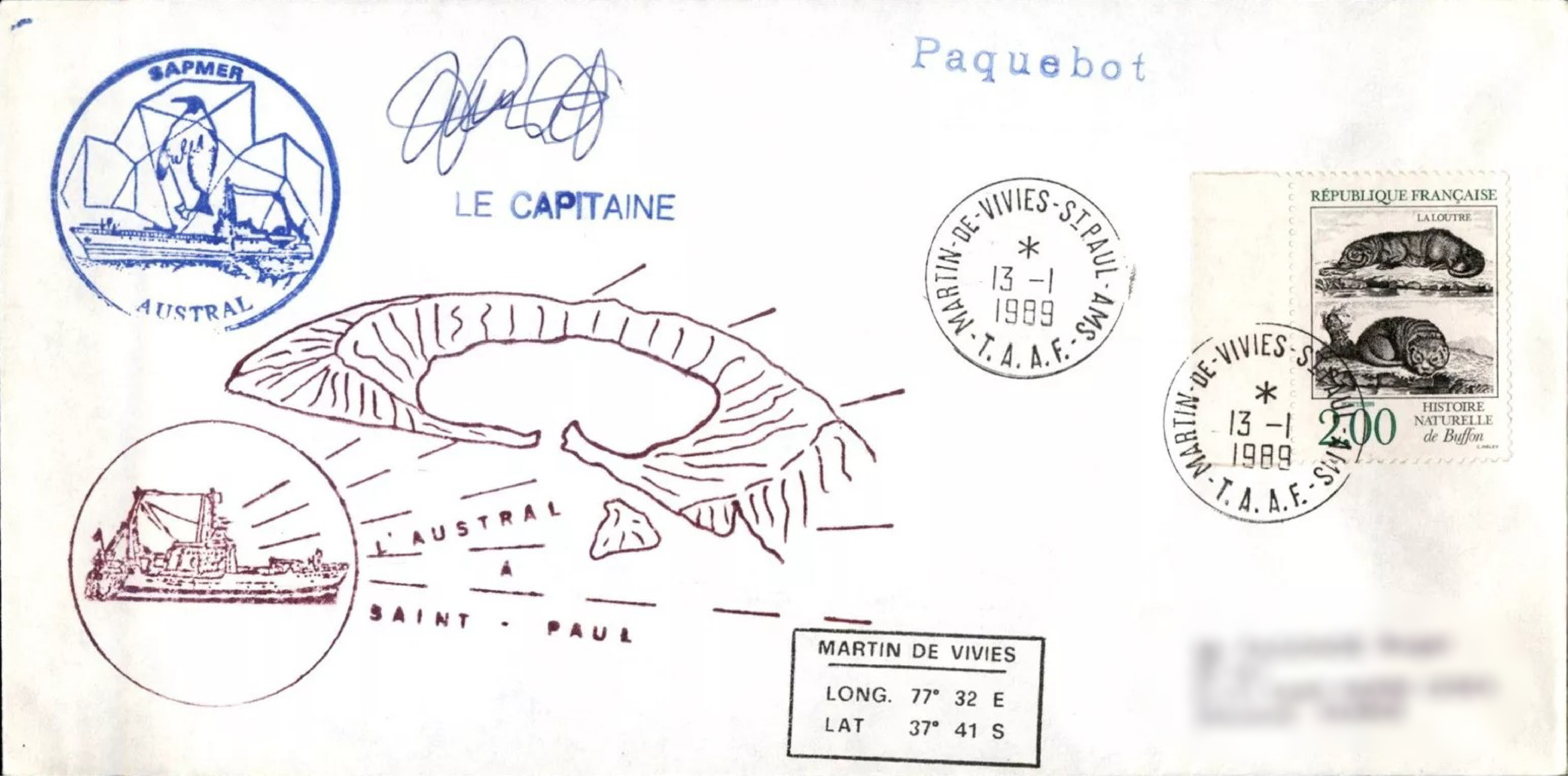
It is this communicative aspect that interests me. The cover as a document presents a kind of storytelling about what is happening in the field. When I’m considering whether a new cover is right for my collection, I tend to gravitate toward examples that have some cohesive narrative that plays out in the design decision details. I’m drawn to mechanisms that enable rapid customization of a cover in the field, to record information about conditions or some variable of the expedition that couldn’t be planned for ahead of departure. Some polar philatelists collect serial dispatches from one location over time, but I’m drawn to pieces that can stand alone and tell the story without the sequential diachronic context. In terms of eras, while I’m fascinated by the stories of the Pioneer Period (everything up to 1954) my philatelic interests focus on items from the Modern Age (1954-onward). While I collect both southern and northern items, I prefer the north, for reasons that will become apparent.
What really drew me to polar philately is that I’m using it to learn about expedition communication as a practice. The abundance of commemorative event covers from polar expeditions indicates that the production of philatelic items by expeditionary crew is an important element in communicating expeditionary research to a broader public.
There is a supply and demand relationship between collectors and personnel from the polar bases who respond by obliging the requests of collectors to send a piece of mail from the poles. I read this as evidence that people between the poles want to know what’s happening on the poles. But the National Science Foundation finds this annoying, and in the early 2000s they began actively discouraging personnel from engaging in “unauthorized philatelic activities.” The NSF views this collecting audience as interfering with the research mission of expeditionary endeavors (The Antarctic Sun, 2003).
But there is something incredibly human about the relationship between those who journey to tell stories of their travels. Travelogues, oral storying, and recounting tales from a journey to an audience are old and ancient practices that transcends cultures, and is one of the basic narrative structures of the monomyth known as the hero’s journey. Recounting experiences to others and relating the details of things we see expands how we understand ourselves in the context of existence, which is critical in perpetuating wonder and curiosity about the world we live in; incidentally an idealized motivation and a goal of Science proper. I say this as a credentialed scientist myself; it is the obligation of the one who has seen to tell others what has been seen, to bear witness of what we try to understand.
Stories helped sustain public interest in expeditions, and the near-mythic narratives of the Heroic Age of polar expeditions relied on a curious public with a thirst for the exotic. Philatelic items were one tangible way that gave recipients the sense of connection to the extraordinary activities of polar exploration as they unfolded. These covers were more than mere tools of public relations, they were actual artifacts of the exploration itself. Beyond mere extensions of the intellectual craftsmanship of research pursuits, expedition covers uniquely hold an aura of intrigue since, unlike academic reports, the covers (as discrete objects) participated in the journey of an expedition, giving the cover the status of something like a relic, or perhaps a portal. An object that delivers to collectors a partial conceptual access to a distant moment both in time and space.
When a collector (or their estate) liquidates their collection, it brings to market a fresh opportunity to own something significant, with a story that has likely been forgotten. When I acquire a new piece for my collection, I read up about the context of the expedition, the sender, the research, the timeline, and I’m not alone in this. A fresh purchase of an old object spurs on a kind of renewal of interest in the events signified by the cover, which incidentally forms my practical motivation for collecting expedition covers.
Beyond my primary motivation of surveying philatelic items as channels of communication, I have a secondary motivation to design event covers for my own expeditionary activities. In 2022, the Center for Art + Environment at the Nevada Museum of Art acquired the archives for my expeditionary practice, and the research in my archive is focused on tracing the movement of glacial stones north from the Great Lakes to the Arctic Circle. I am now in a long process of organizing an expedition to the Barnes Ice Cap on Baffin Island in the Northwest Territories, and my expedition will produce postal artifacts as a record-keeping practice. My expedition to Baffin Island will return a glacial erratic to the remnant of the ice sheet responsible for moving it south during the last Ice Age. The Barnes Ice Cap is the remaining slab of ice from the Laurentide Ice Sheet.
As I design the covers for my expedition, I’ve begun collecting historic pieces with new interest, and shortly after my archive was acquired, I began thinking through the various ways I could tell the stories of my expeditions. It only made sense that I began thinking about how I could fold philately into my communications strategy, and in my preparations and training expeditions, I’ve produced a number of cover designs. I’m a member of the American Society of Polar Philatelists, and I’m making training covers from training activities south of the Arctic Circle, but do these pre-expedition works count as polar philately? I believe they do.
There is some precedent for considering training activities within the category structure of polar philately. In fact, one of the first polar covers I collected was produced by the Belgian Polar Exploration Society during a training expedition in 1989. Depicted on the cover a team of two explorers (presumably the cover signatories) trek across an ice field towing a pulk sled past two onlooking polar bears. Above this scene, a text stamp describes the departure site and provides the commentary “NICE BUT COLD -45 CELCIUS.”
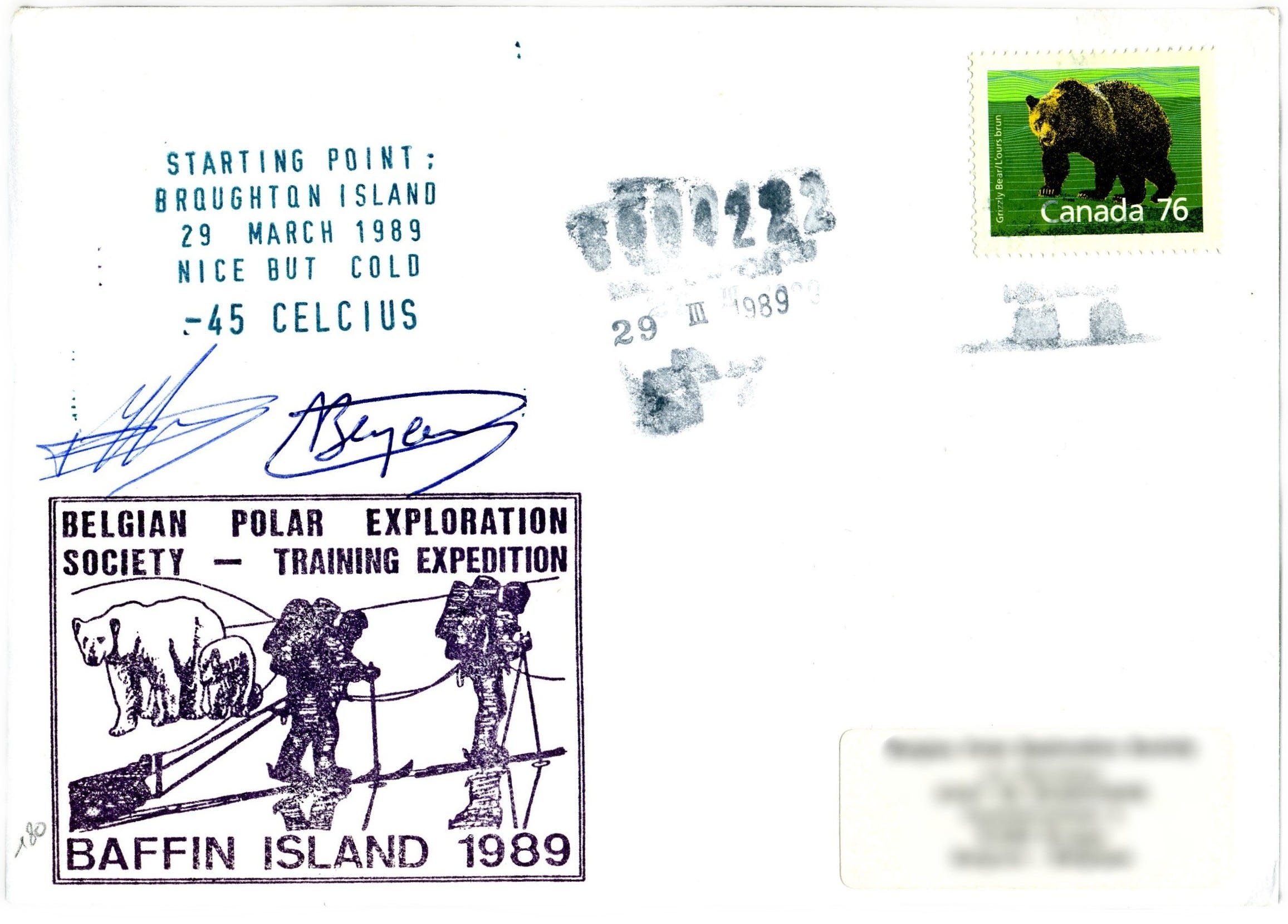
But in the years since I acquired this Belgian cover, I am yet to find another item from a training expedition, and while I’m sure they exist, with the exception of archives, I have not seen much discussion of the artifacts of expedition preparation correspondence. So when the notable polar philatelist Hal Vogel wrote in a recent issue of Ice Cap News (Vol. 69, No. 4, p. 94), that Amundsen’s 1925 flight expedition was formed in 1924, and even earlier with “feeble polar flight attempts” in 1922, the assertion that these early years of training mattered to the discipline of polar philately gave me some hope that maybe what I have to offer could be of interest to the community at large. If we take an expanded view of contemporary expeditionary preparations as belonging to the strict schedule of what counts as polar philately, maybe what I have is worth sharing. And so, long before my boots hit Arctic ice, I am sharing my current training (south of the 60th parallel) as a case study for the under-explored territory of polar expedition preparation, and the philatelic items they produce in the lead up to the expedition proper.
Toward that end, I’ve prepared a series of articles that will describe the particulars of my training expeditions and will posit a series of generalizations that might help other collectors expanding their collections to include materials produced in the lead up to expeditions on the poles. In the next article, I’ll share some of the covers my training activities have produced and I’ll describe the actual objects I produced. I’ll also look at several specific influences from polar philately that I drew on in my design process, and I’ll draw connections between the covers I collect and the covers I produce. I will catalog some of the mechanisms found on polar covers that enable in-field customization that I’ve adapted in my approach to presenting data samples from my activities, rendering the cover as a poetic artifact of the expedition research. The third article will look at an approach I take that can be seen as a kind of philatelic outreach, sharing the discipline of philately with new audiences who might be more interested in the content than the mechanism, and how I’ve been able to convert the content-seekers into philately-minded collectors who otherwise might not know about the formalized discipline of philately. My fourth article will consider questions of contrivance and authenticity in philatelic mail pieces. My fifth article will take an expanded view of the journey that a cover takes through contemporary mail systems by looking at a collection of 101 identical covers sent during my training, and treating that collection as a corpus that can be analyzed for details about implications the mail system has on contemporary expedition practices. A goal for all of these articles is to solicit input from the polar philately community to help refine my process and design. Knowing that my articles describe preparatory work done outside of the Arctic Circle, I thank you in advance for your generosity in reading these articles and invite your feedback.