
Documentation & Accretion in Expeditionary Postal Practices: A Digest

Documentation & Accretion in Expeditionary Postal Practices: A Digest
Origin: FIELD OFFICE (Practice)
Post Type: Series Overview / Contextual Guide
Date of Publication: 2026-01-18
Related Divisions: FIELD OFFICE, STUDIO, GEOCOG
Purpose: Provide an index and interpretive context for a five-part series on contemporary philatelic practice as it intersects with FIELD OFFICE, studio research, and expeditionary documentation
Author: RYAN DEWEY
ACCRETION & LEGIBILITY
Postal materials appear in my practice because they sit at an unusual intersection of infrastructure, evidence, and time. They are designed to move through systems, to be handled, marked, delayed, and rerouted, and in doing so they accumulate traces of those systems in ways few other media do. An envelope is never just a container. It is a record of coordination across institutions, standards, geographies, and hands.
I am interested in postal artifacts not for their imagery or nostalgia, but for their procedural density. Rates, cancellations, routing marks, inscriptions, and wear patterns are all signals. They document decisions made under constraint, often invisibly, and they persist as physical residue long after the operational moment has passed. In that sense, postal materials function as compact field reports.
Working with them allows me to study how abstract rules become material outcomes, and how large systems leave legible traces at human scale. The postal system is not my subject so much as my instrument.
If you enjoy documentation for its own sake, you are in the right place.
A DIGEST
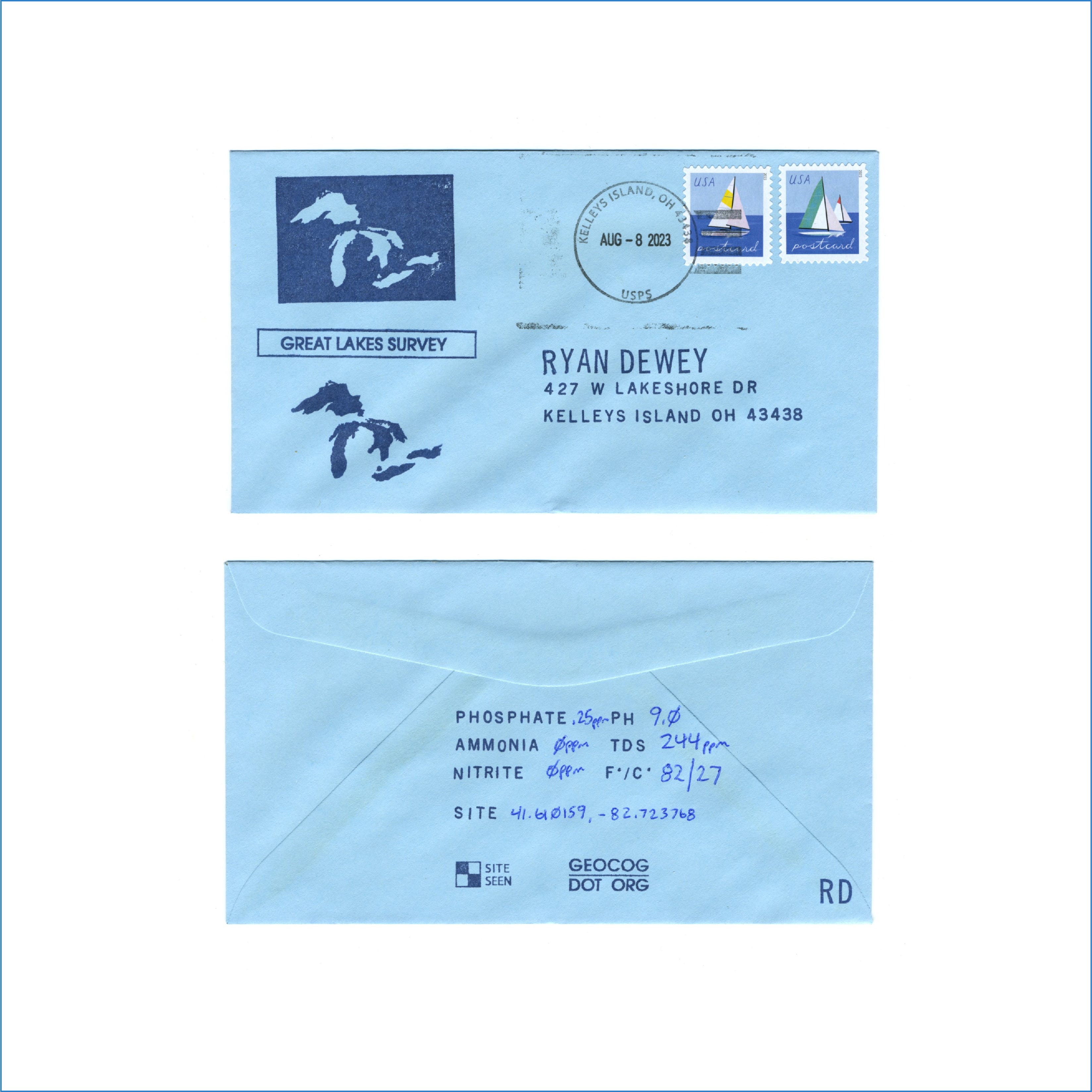
This post serves as a guide to a five-part series exploring how the objects produced through my studio practice (covers, postcards, and related dispatches of works on paper) exist simultaneously as official records of expeditionary activity, as artifacts within contemporary philatelic discourse, as 2D works from my studio, and as elements of FIELD OFFICE documentation.
I recognize that this material is specialized. It is not intended for every inbox, and I wrote this digest to function as an entry point for those who wish to engage more deeply. If this isn’t for you, just skip it and come back with my next post. But if you are curious (and I hope you are), here is a summary for readers who want a concise overview, followed by a suggested reading path for those ready to navigate the full archive.
SUMMARY OF PRACTICE
Across these five articles, I examine how postal artifacts (whether produced during training expeditions, in the field, or as mobile observation tools) mediate between personal record-keeping, public communication, and formalized philatelic practice. The objects are simultaneously:
Reflective artifacts of my studio practice, capturing procedural decisions, field observations, and creative design systems.
Participatory documents in contemporary philately, entering the postal system under real-world conditions and engaging with established collectors’ norms.
Official records of expeditionary activity, including training exercises, site-specific field observations, and longitudinal monitoring of movement and landscape.
This duality makes categorization difficult. The pieces operate across multiple communities, from art audiences to philatelists, from curators to fellow spatial practitioners, all while preserving their documentary and communicative functions.
THE 5 MAIN ARTICLES
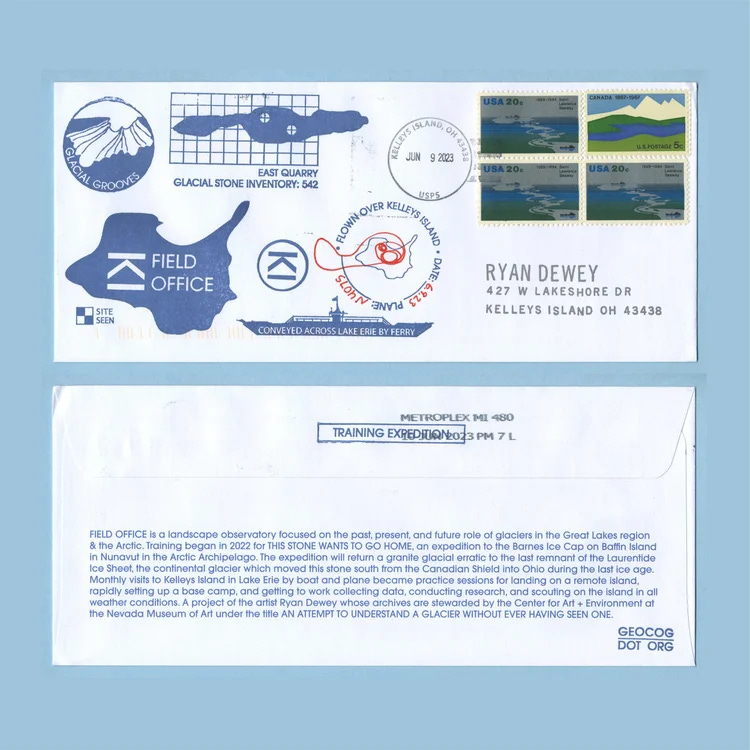
Do Postal Artifacts from Expedition Training Qualify as Polar Philately?
Introduces the conceptual framing of expeditionary postal artifacts, arguing for their inclusion in polar philately and situating training covers within the broader practice.Proof of Concept: Designing & Testing Expedition-Related Postal Artifacts
Describes design strategies and practical testing of covers and templates, showing how objects were iteratively developed in the field.Postcards from Around the Great Lakes
Examines postcard-based field records, including boxed dispatches and the SITE SEEN mapping project, emphasizing materiality, movement, and philatelic outreach.Is This Philatelic Mail or Contrived?: Authenticity, Contrivance, & A Porous Boundary
Explores the contested distinction between authentic and contrived mail and situates my work within that debate, highlighting the dual status of designed correspondence as both artifact and functional mail.Patterns in Postal Damages: Forensic Analysis of Mishandling Errors in Expedition Covers through Automated Sorting Processes
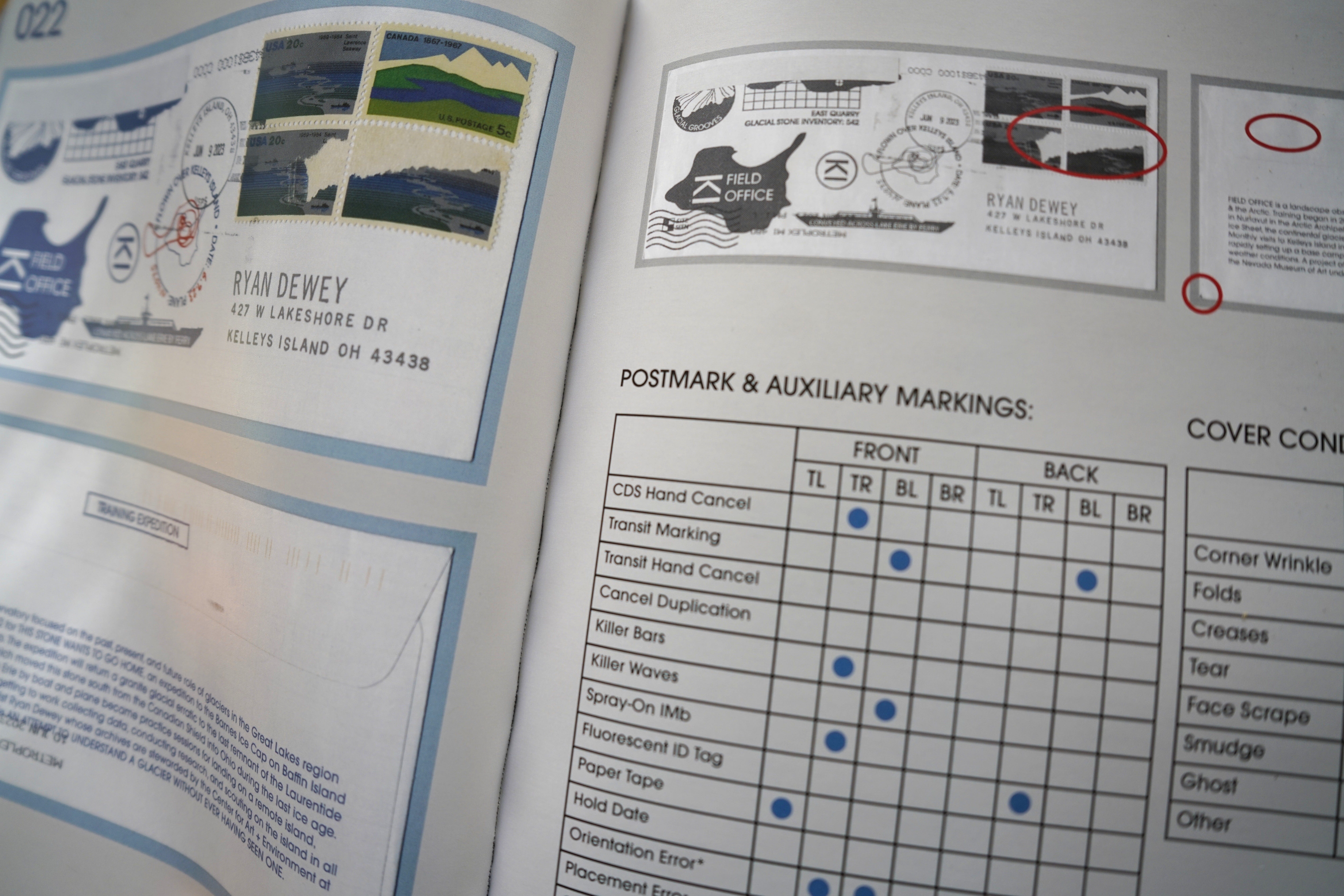
Provides a data-driven look at how a set of 101 identical covers interact with contemporary postal systems, including errors, damage, and processing outcomes, adding a layer of material and procedural insight.
ENGAGING THE ARCHIVE
Selections from these objects have been shown in exhibition contexts, while others (such as the set of 101 covers and their catalog corpus) remain largely unpublished. This digest is designed to allow curators, researchers, and art audiences to conduct close readings of the texts and images without imposing on broader mailing lists.
If you wish to explore the series to its full depths, follow the order above to experience both the conceptual framing and the practical, material documentation. It’s dense, but the function of these articles is to benchmark the inherent structure of this aspect of my practice. For readers seeking a high-level understanding, the summary above situates the works within my ongoing exploration of expeditionary practice, studio methodology, and contemporary philately.
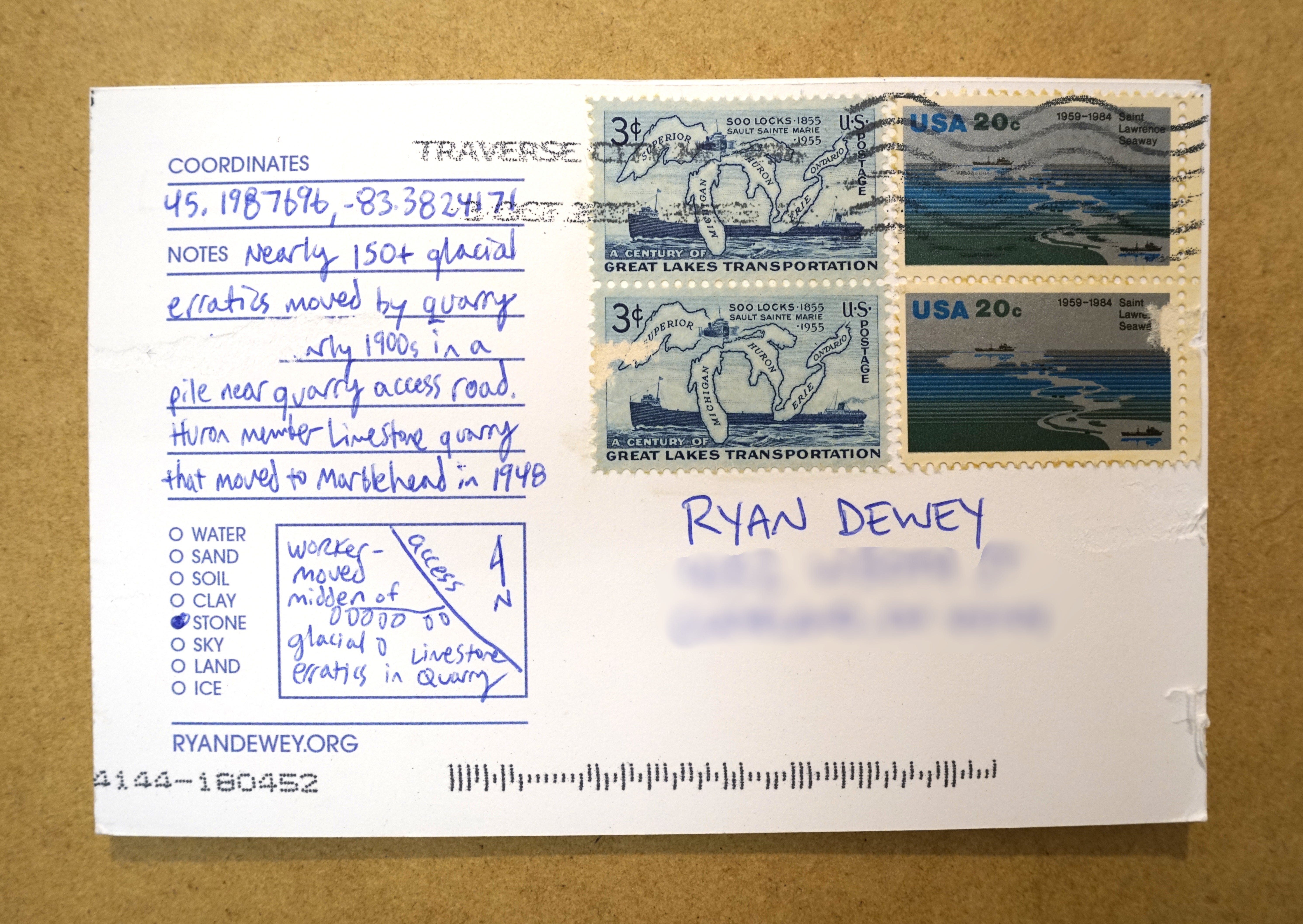
I’m primarily focused on accretion, movement, and documentation here; the stamps are incidental and convenient as tools to manifest the visibility of a systems view in an clear way. My goal is not to shift this channel toward postal history, but to lay down foundational benchmark pieces that document a parallel, cross-disciplinary practice that outlines an aspect of spatiality that co-evolves with my research, travels, and production.
Most of the items depicted in these posts are available for circulation and exhibition. I’d like to find the right institutional home for the set of 101 covers, in particular. Enquiries are welcome.
Thank you for reading.