
Slow Looking and the Work of Attention: Encountering Everglades Cord

Slow Looking and the Cost of a Quick Glance
Most sites and objects are first encountered at a distance, and most of the time they are dismissed just as quickly. A glance is enough to categorize. Enough to move on. It’s how we convert new information into background information in the search for relevance and significance.
This habit of rapid categorization is efficient, but it is also deceptive. The quick read often tells us more about expectation than about what is actually present. In fieldwork, in landscapes, and in encounters with material objects, that initial reading is frequently wrong, or at least incomplete.
Much of my work revolves around the gap between first impression and sustained attention. While looking is incidental, it is also a subject in its own right. I explore how recognition emerges over time through repetition, proximity, and careful engagement, and how objects, sites, and materials respond to the rhythms of observation.
Everglades Cord is one attempt to make that mechanism visible.
The Deception of the Ordinary
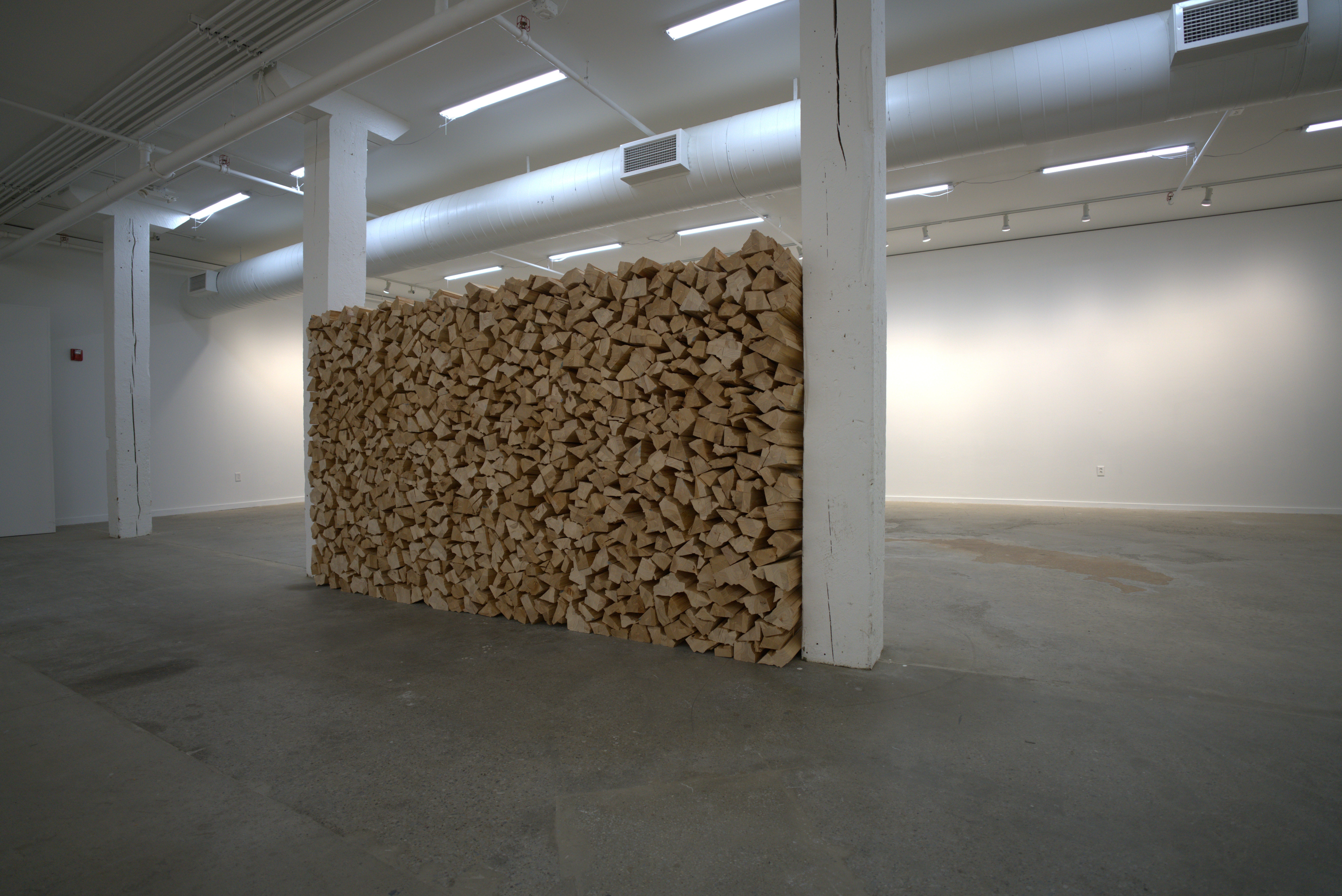
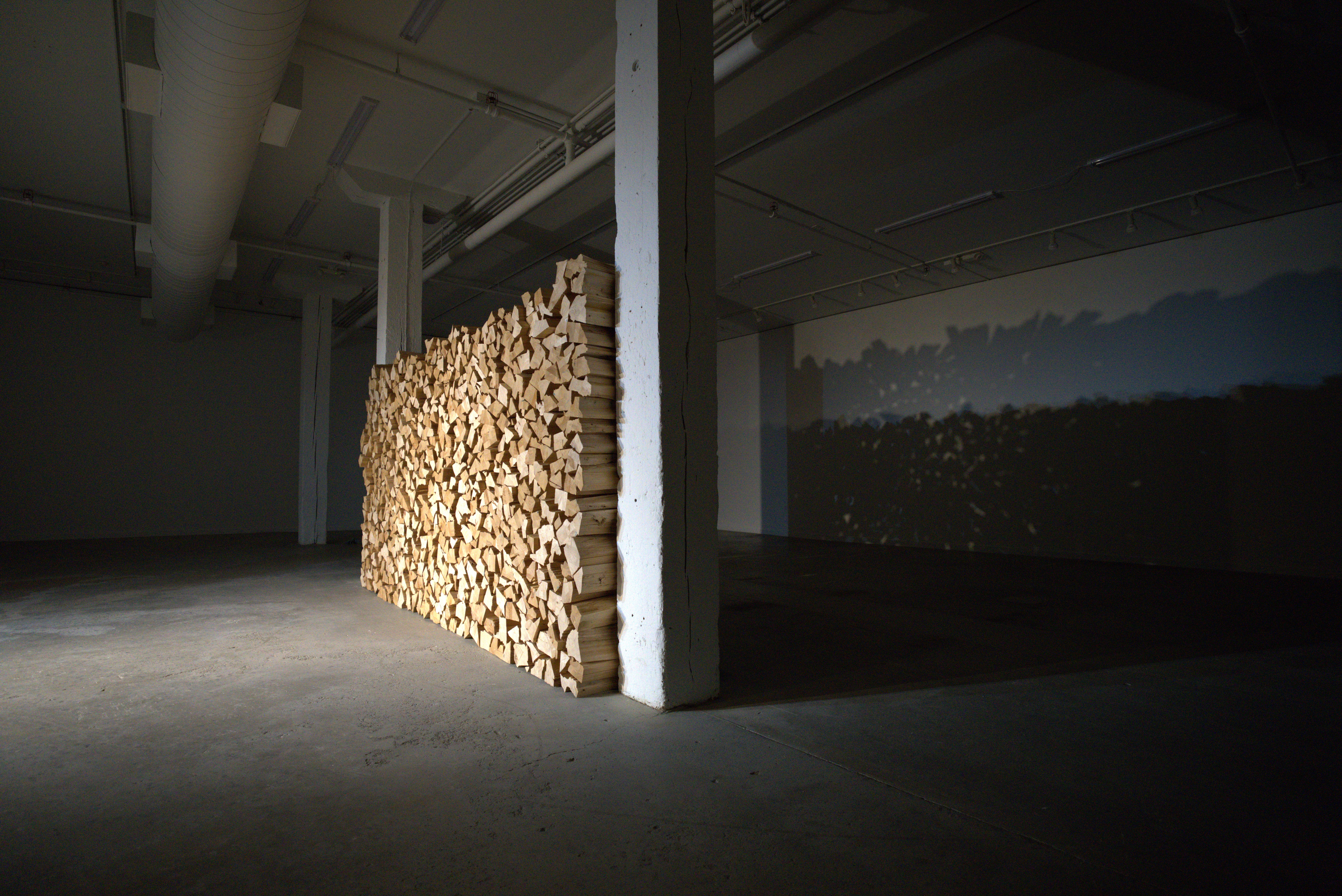
At first glance, the work reads as a simple stack of split firewood. It is easy to pass over. Many people do.
That misreading is not incidental. It is structural to the piece. The form borrows the visual language of the ordinary, the utilitarian, and the overlooked. Only when attention slows does the object begin to resist that reading.
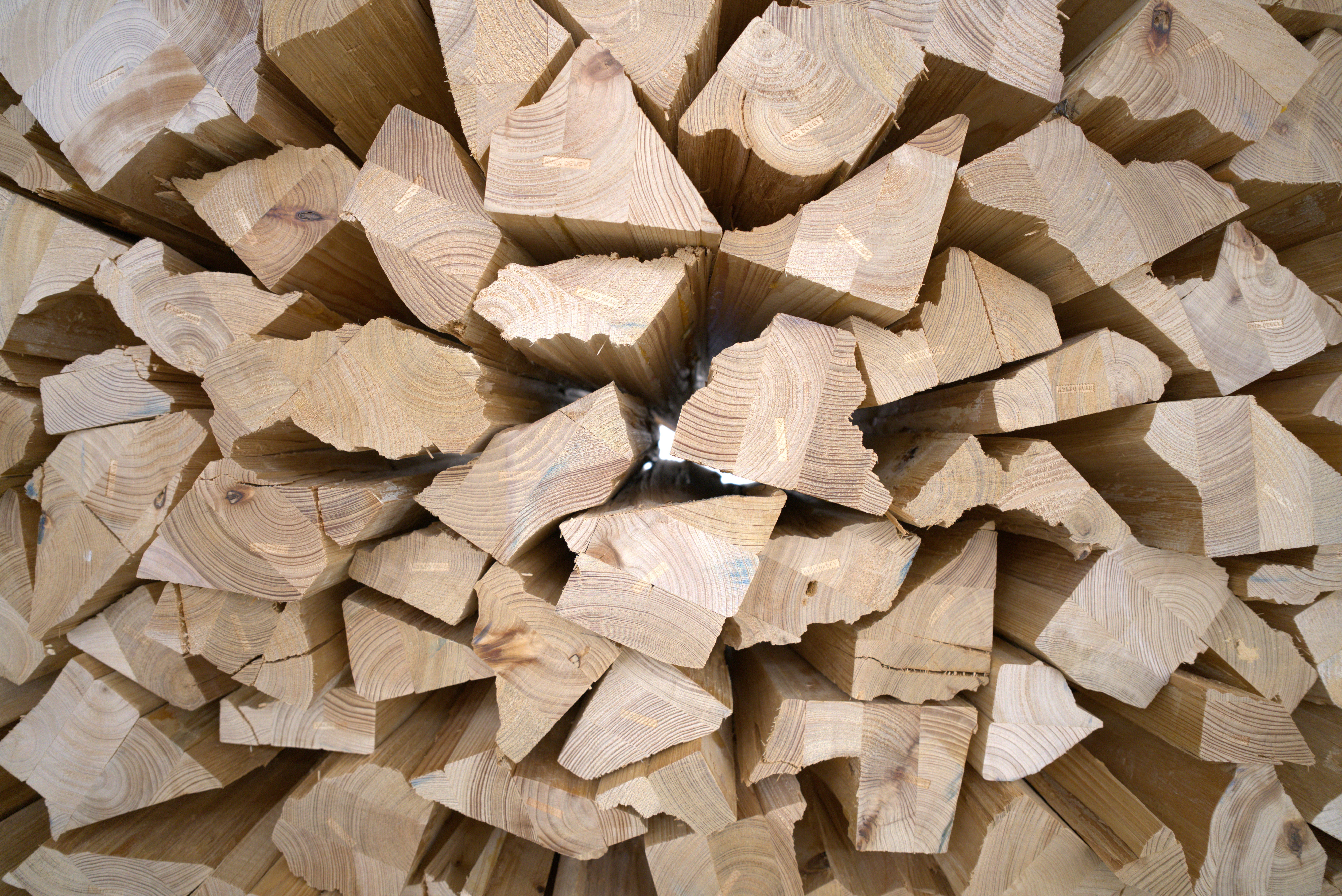
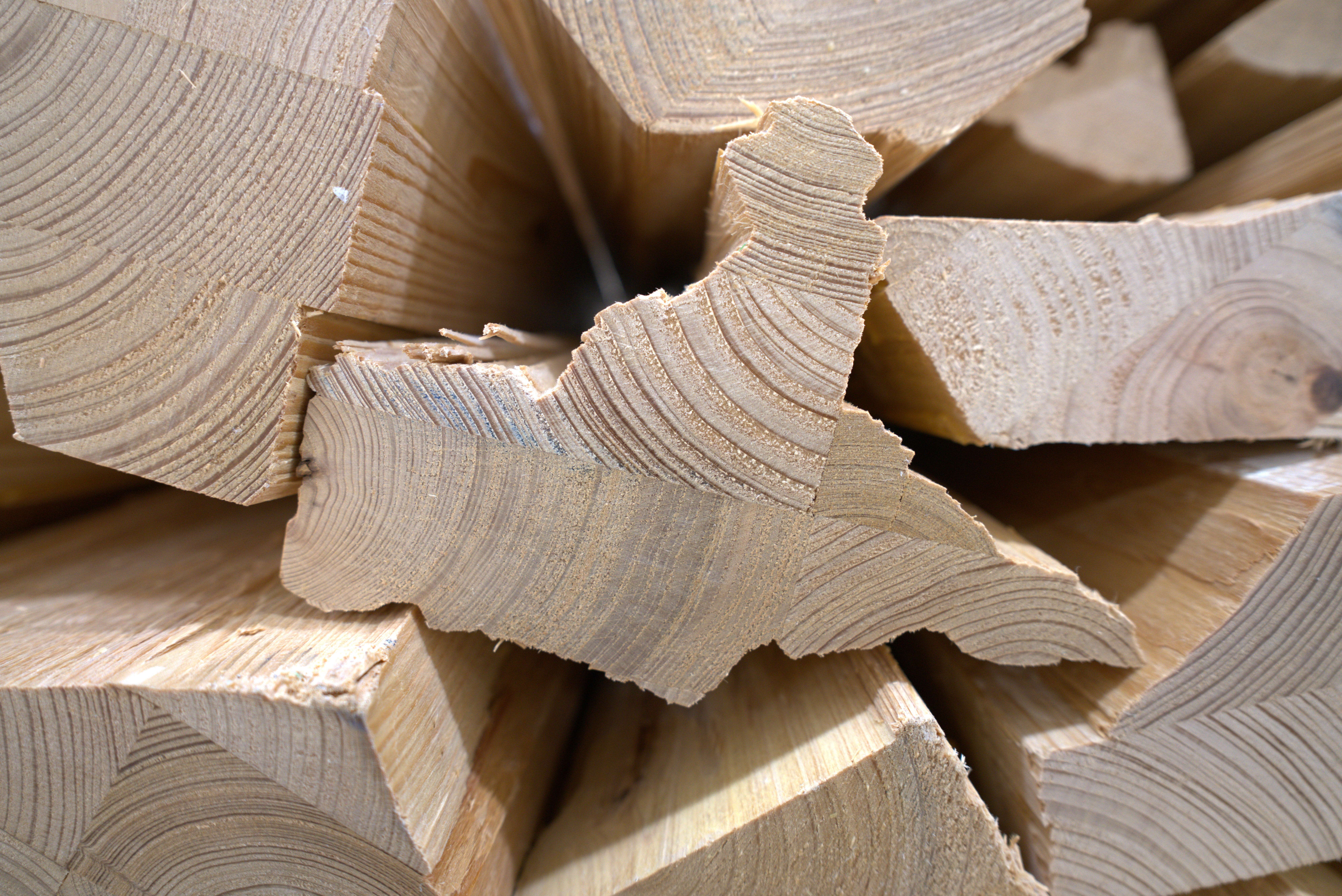
Closer inspection reveals that each log is fabricated rather than split from a tree. Seams, join lines, growth ring-pattern mismatches, and subtle inconsistencies in grain and knot placement come into view. There are also absences. Voids shaped like logs that once occupied those spaces and are no longer there. The stack begins to read less like accumulation and more like construction.
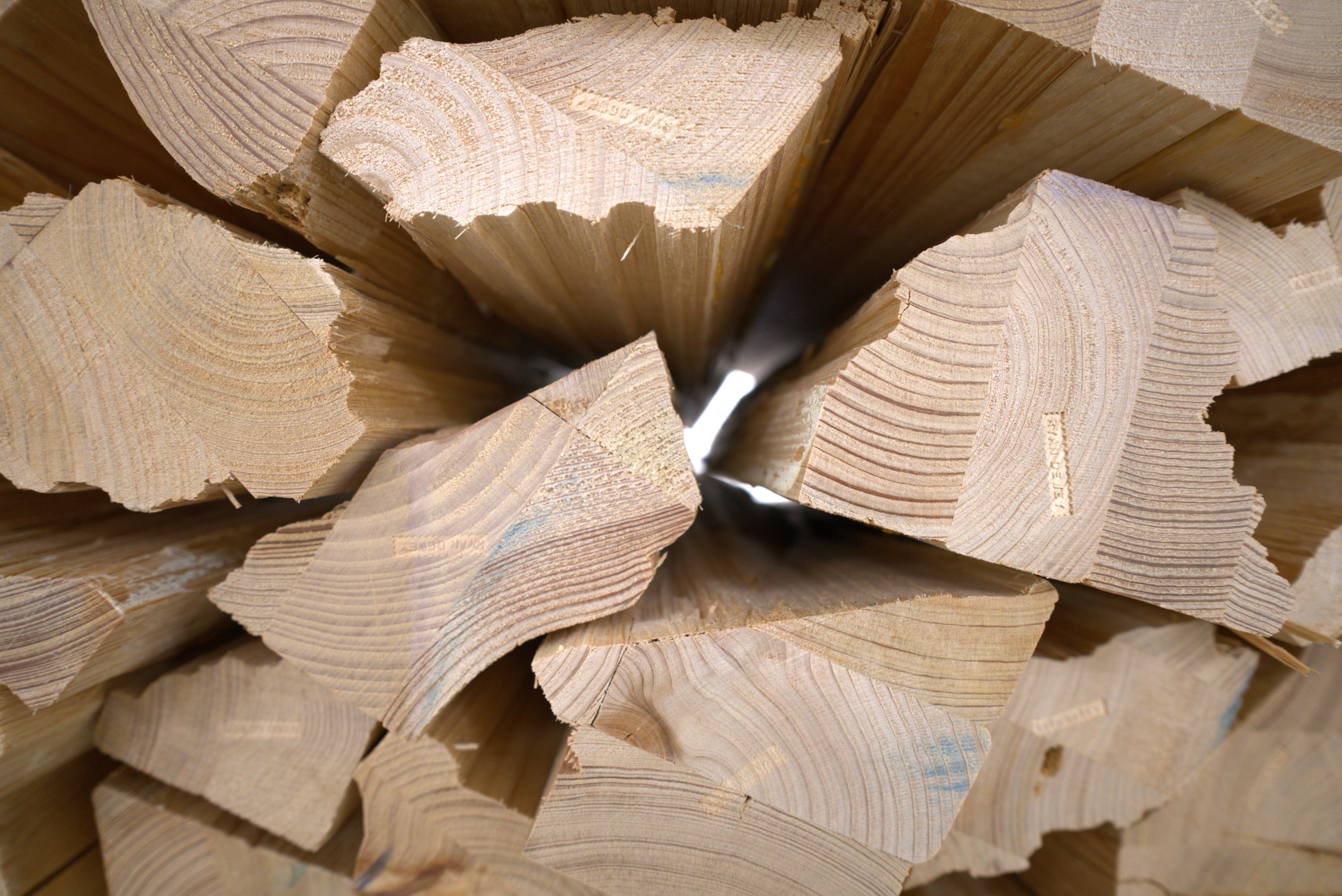
The shift from glance to recognition is the work. Not metaphorically, but operationally. The object is designed to reward proximity and time, and to withhold itself from cursory interpretation.
Attention as a Material Process
Attention is not neutral. It has structure. It is shaped by habit, context, and expectation.
In fieldwork, I have learned that repeated engagement with a site often produces entirely different readings than an initial visit. What looks like debris becomes evidence. What appears random begins to show pattern. What felt resolved opens into further questions.
The same dynamic is at play here. The work does not announce itself as sculpture. It requires the viewer to press in, to investigate, to test their own assumptions about what counts as form and what counts as residue.
This is not an argument for slowness as virtue. It is an observation about how understanding actually accumulates.
Material, Source, & Labor
The cord is built from reclaimed cypress lumber believed to have been cut from South Florida swamps before current protections on the Everglades banned logging. The wood was acquired legally, long after it had been removed from the landscape and stored following the closure of a furniture company.
No protected trees were cut for this work.
That distance in time matters. The material carries with it a layered history of extraction, storage, reuse, and transformation. It is no longer a living tree, but it is also not neutral matter. Its prior life in a wetland system, its removal, and its prolonged dormancy are all embedded in the work.
Each log was assembled through deliberate, repetitive labor. I shaped and joined fragments of lumber into forms that could convincingly pass as split firewood. I broke conventional rules of joinery so that when split with an axe, the edges would read as real. Knots and grains were arranged to preserve the illusion of having come from a single trunk.
That labor matters. As Thoreau noted, firewood warms twice, once in the work of carrying and cutting, and again in its burning. Here, the warmth is abstracted. The stack holds both the labor embedded in its making and the larger, less visible heat released through canopy loss and extraction. Each time the work is moved, from studio to gallery and back again, that warmth accumulates through handling and care. The cord remains reversible. It can circulate as artwork, as stored fuel, or, at the limit, as a funerary pyre. In that final transformation, labor, material, and heat collapse back into the body that assembled them.
Looking Through the Work

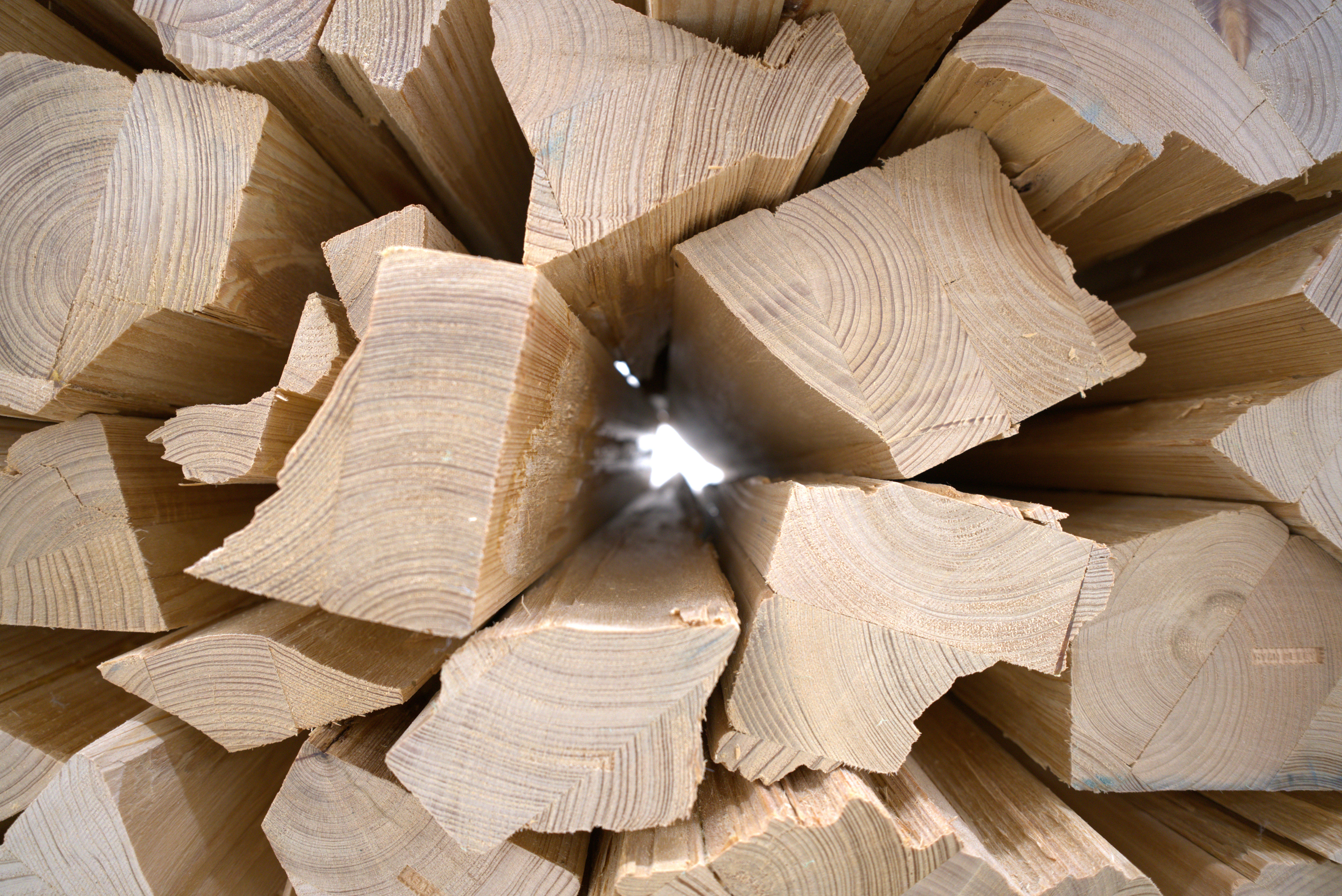
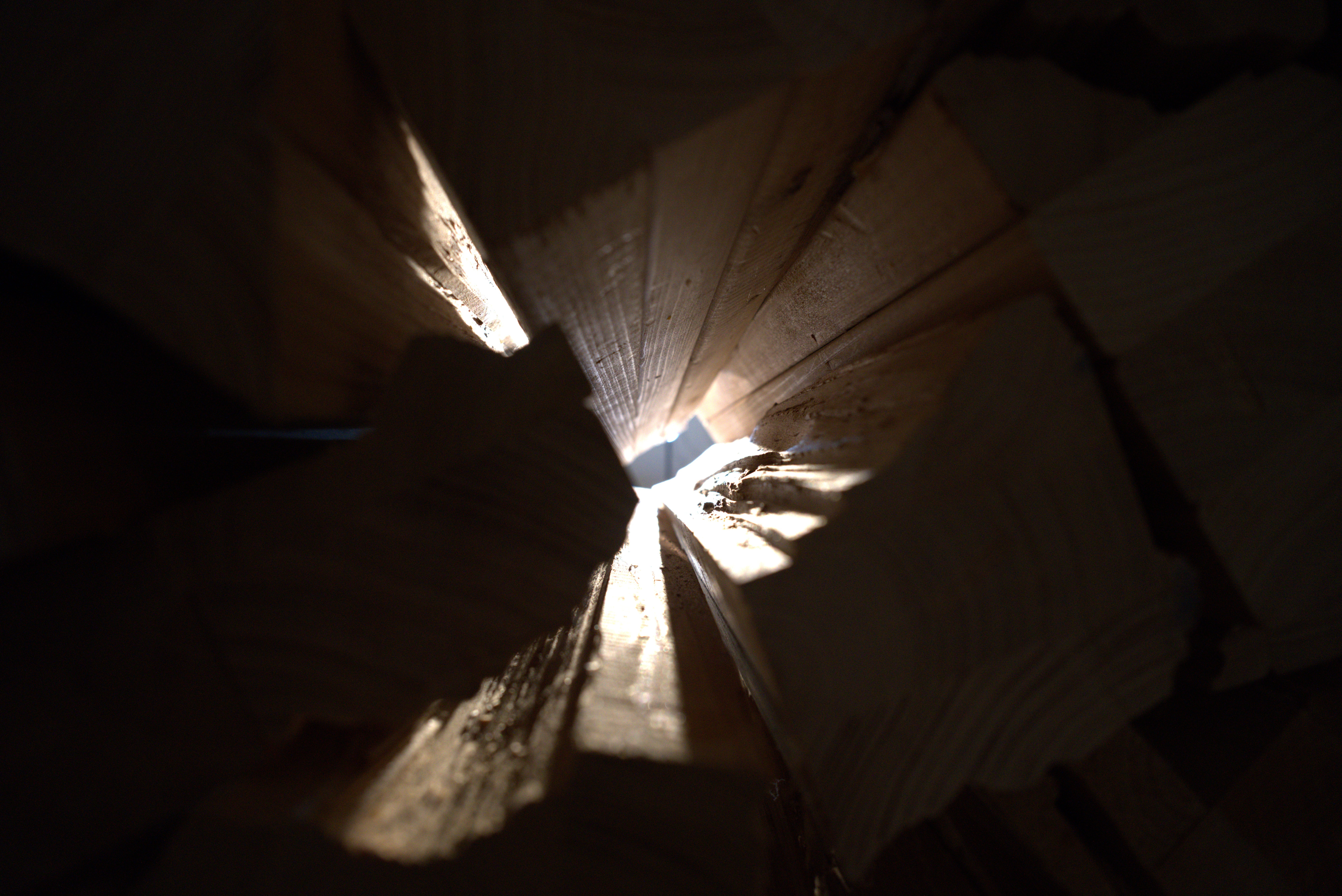
As attention deepens, the cord begins to function less as an object and more as a frame. Light passes through the interstices between logs. The gallery wall beyond becomes visible. The stack shifts from mass to aperture.
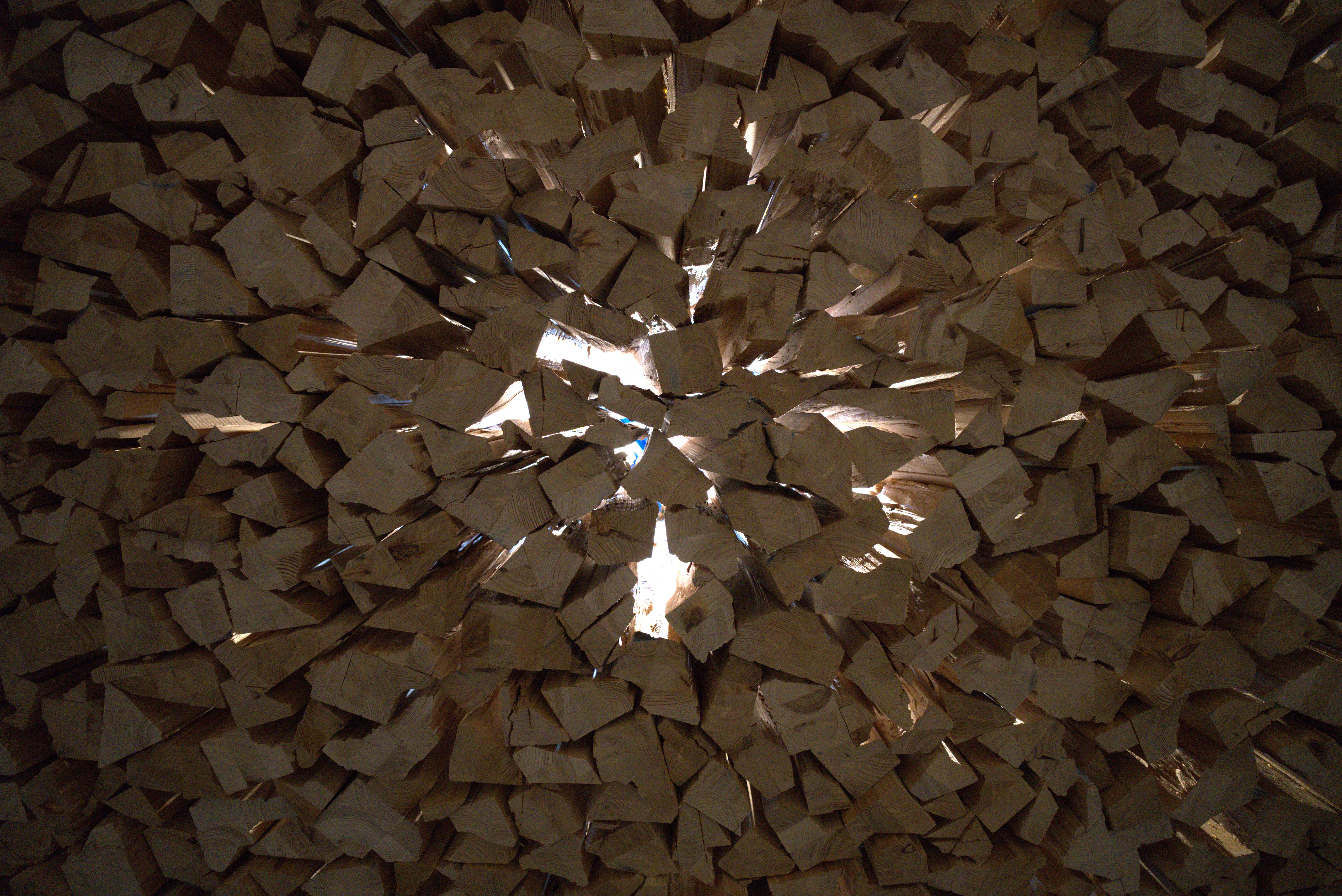
This quality has led to a related line of inquiry. The porosity of the stack holds the potential to act as a large-scale pinhole camera. I intend to return this cord of pre-ban cypress to the swamp from which it was originally cut and construct a purpose-built crate that doubles as a camera. Hundreds of small apertures between the logs would admit ethereal light onto a large sheet of photographic paper, producing a diffuse, spectral image of the surrounding canopy. I have built a smaller functional model of this camera to produce test prints.
Wood returns to site. Canopy becomes image. Memory is fixed in emulsion.
This extension is not a departure from the original work. It is a continuation of the same attention mechanism, pressed further.
A Longer Geological Memory
Everglades Cord also sits within a broader arc of research I have been pursuing through FIELD OFFICE across the Great Lakes region. That work traces landscapes shaped by ice, water, and limestone, and the deep histories that connect northern and southern ecologies across geological time.
In some reconstructions of plate tectonic movement, the continental block that would become the Great Lakes region occupied positions much closer to the equator, and in earlier deep-time interpretations, at times south of it. During long intervals of the Paleozoic, shallow tropical seas covered much of this terrain, depositing the limestone that now underlies large portions of the region.
These conditions supported ecologies markedly different from the present. Warm, shallow marine environments and later wetland systems left material traces that persist beneath glacial overprint. Cypress and cedar, both closely associated with limestone substrates, function as botanical indicators of those deeper continuities, even as climates and latitudes shifted dramatically over time.
This is not a claim that the Everglades and the Great Lakes are equivalent landscapes. Rather, it is an acknowledgment that they are connected through a long arc of material formation, plate movement, and ecological succession. Southern swamp and northern quarry are separated by latitude today, but linked by substrate, memory, and the slow rearrangement of the planet itself. In the Great Lakes region, these deeper limestone and marine histories are partially obscured by glacial overprint, where ice reshaped the surface while leaving earlier substrates and their ecological signals intact beneath.
The cord, built from southern cypress and encountered in northern contexts, carries that tension. It is a displaced material that quietly points back to a geological history in which present distinctions of north and south had not yet settled into their current positions.
Why Pressing In Matters
In landscapes, in archives, and in objects, the quick glance is almost always insufficient. It flattens complexity and reinforces expectation. Deep looking does not guarantee understanding, but it creates the conditions under which understanding can emerge.
This is as true for a stack of wood as it is for a quarry face, a glacial groove, or a site long shaped by human and nonhuman forces.
The work asks a simple thing of the viewer. Slow down. Move closer. Stay with what resists immediate recognition.
Often, that is where the real structure begins to appear.
My practice often reads like a pile of wood at first glance: dense, ordinary, and easy to overlook. But spend time with it, move closer, linger, and the structure begins to emerge. Materials, methods, and histories interlock across projects. Attention reveals patterns that are invisible to a casual scan. In that slow unfolding, the work becomes legible, and the world it constructs begins to draw you in.
Explore Everglades Cord and other works in my studio practice on my website. See how materials, labor, and sustained attention come together to reveal hidden structures, perceptual dynamics, and the layered histories embedded in each project.