
Morphologies of Displacement
Notes on continuous inquiry from an autonomous research practice

Research proposals are usually treated as administrative documents, private exchanges between applicant and institution. But in my practice they hold a more primary function.
A proposal is a record of where the work stands at a given moment. It indexes which questions have stabilized, which methods have matured, and which lines of inquiry are ready to withstand external scrutiny. It is less an appeal than a snapshot coupled with a vision for what lies ahead.
For that reason, I treat proposal cycles as part of the publication rhythm of my practice. They mark transitions in emphasis and evolutions in focus. They mile mark the trajectory of an inquiry already underway, upstream of any conclusion or closure.
Scholarship, field investigation, spatial intervention, and modeling are treated here as equivalent research outputs. Proposals emerge from that production. They are closer to field reports than applications, documents that register where the work has been and where it is moving.
Recently, two proposals were evaluated through competitive funding cycles and did not advance. As part of a longer research arc, their evaluation marks a moment in the project’s development rather than a conclusion, and the work continues to evolve within the broader trajectory of the research program.
Research timelines and review timelines don’t always align, but that doesn’t mean I can skip this part of the project just because it wasn’t funded. It does have me thinking about the genre that a research proposal is and why it functions the way it does in a practice like mine.
Translation Friction
In Kristoffer Holm Pedersen’s recent essay Seeing the Ground We Stand On (Landezine), Holm Pedersen (Communications Director for SLA, Copenhagen) articulates a structural tension within contemporary architectural and landscape discourse: slow, process-based, ecologically attuned research often resists systems optimized for immediate legibility.
Landscape-scale research operates across temporal registers that exceed conventional cycles of visibility. It requires return, accumulation, and long observation arcs. Its outputs do not always condense into object-based publication formats.
My work is slow by design because the landscapes it studies operate across extended temporal scales. Its pace reflects its subject matter.
This is also reflected in my relationship to institutions that have encountered this work over time. For example, SLA also holds a work produced by my studio during an early phase of the development of this research program documenting post-glacial and post-industrial landscapes in the Great Lakes region. Those same research concerns continue to structure my program today: post-glacial morphology, extraction landscapes, infrastructural memory.
Landscape-scale research exceeds conventional attention spans because it cannot be reduced to the visual alone; it must also be experiential, or it must push observers into experiential engagement in order to approximate understanding of the landscapes being described.
This is the impetus behind my ongoing project An Attempt To Understand A Glacier Without Ever Having Seen One. The work investigates how knowledge can be constructed through mediated observation rather than direct encounter.
This requirement for experience as medium tends to compress audiences when measured against models that treat audience expansion as a primary measure of cultural or intellectual validity.
I say all of this because the two proposals described below sit within that condition.
1) Negative Architectures: Tracing Displacement Logics Across Deep Time
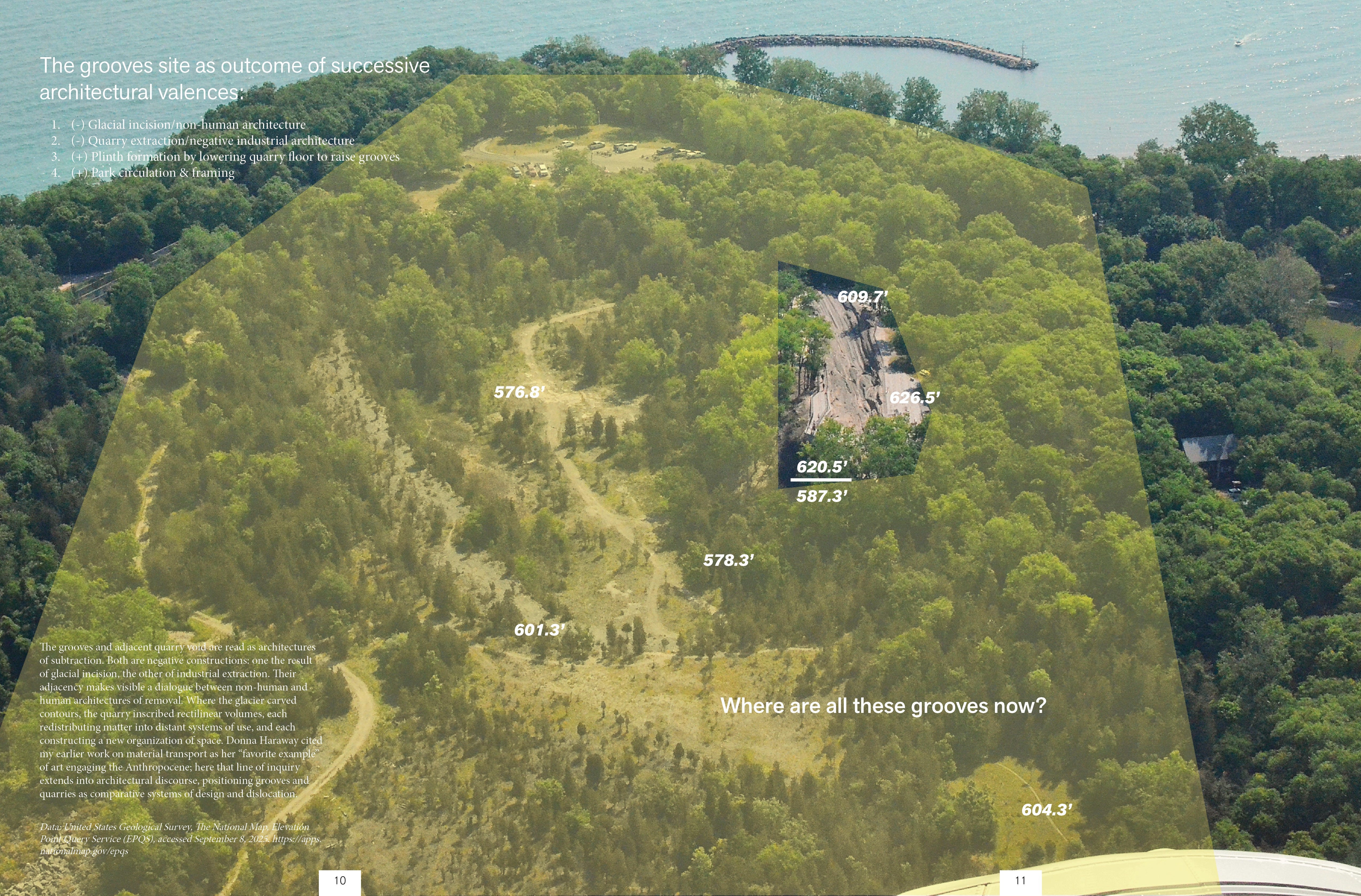
For more than a decade, I have documented glacial grooves, quarry systems, erratics, commemorative landscapes, and infrastructural voids across the Great Lakes region, returning countless times to the same sites but always understanding them anew. These investigations examine (among other themes) the function of removal as a spatial generator.
Glaciers carve.
Quarries hollow.
Spillways incise.
Extraction leaves form.
Displacement leaves memory.
Erosion leaves structure.
I use the term negative architecture to describe landforms produced through subtraction rather than addition, and especially through what persists after the dust settles. These forms operate at multiple scales, from glacial abrasion to industrial excavation to hydroelectric infrastructures such as the Escalier de Géants spillway in northern Quebec.
The current phase of the research extends northward along glacial and industrial corridors linking the Great Lakes to James Bay. Along the way, I proposed tracing several Ohio-found erratics back to their Canadian Shield lithologic origins (Sudbury, Gowganda, etc), to also document quarry systems along the way, and to examine engineered voids as generative, symbolic, and planetary. This project situates architectural thinking within processes of erosion, extraction, and redistribution.
While I draw on metaphor, the goal is more methodological expansion.
Architecture is typically framed as additive. This research argues that removal and accumulation are equally operative spatial systems of production through the delineation of what persists. Landscapes shaped by ice and industry demonstrate that matter itself participates in the production of form across extended temporal scales.
Negative architectures accumulate through removal, it is production through loss (a theme I’ve explored through several exhibitions which might be worth revisiting soon).
I won’t describe the project more here, but the full research dossier, including proposal materials and supporting documentation, is available through the studio archive.
2) When Craft Shapes Thought: Visual and Textual Comparisons in 19th Century Geology
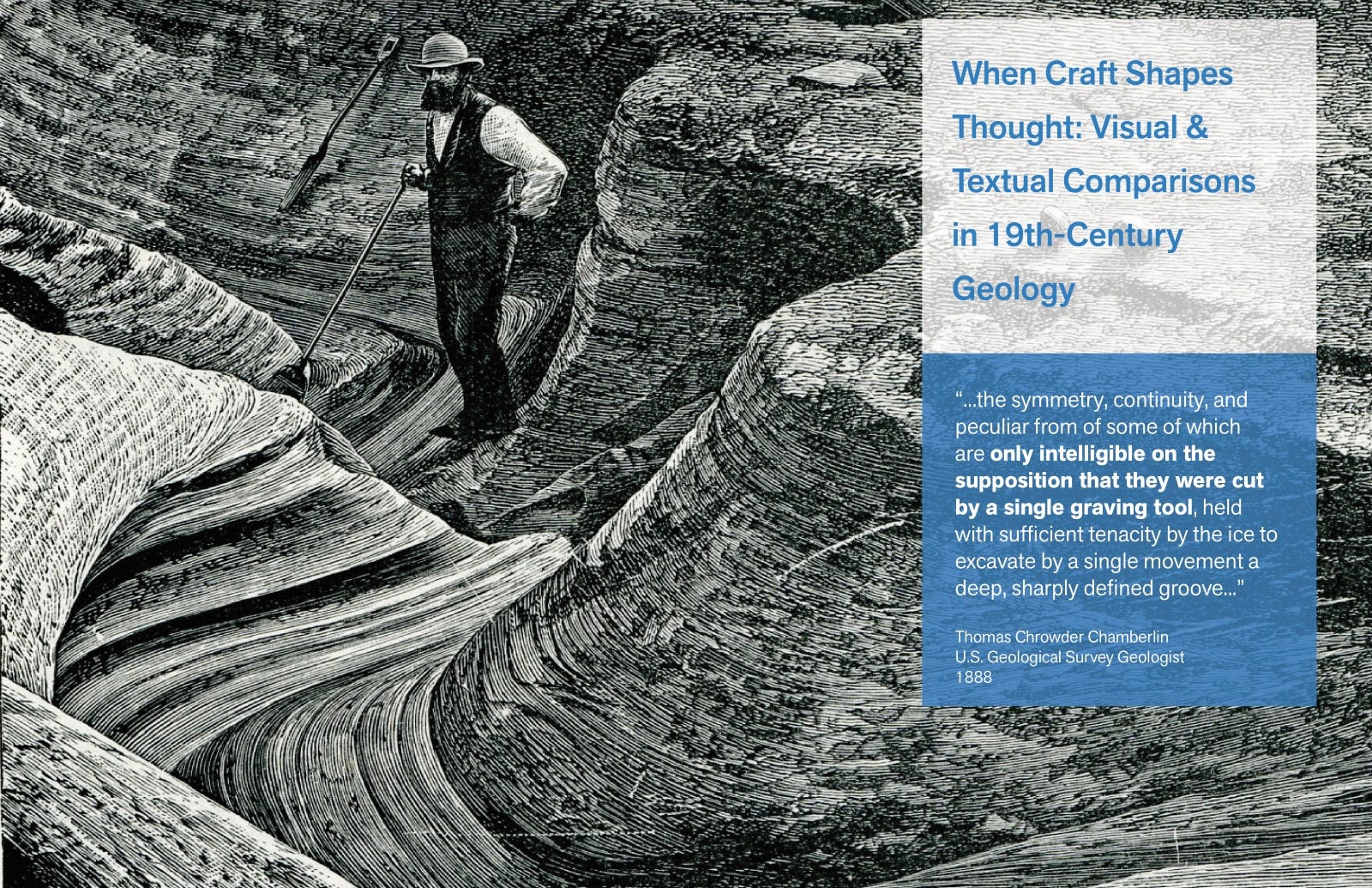
A parallel line of inquiry examines mark-making by removal as a cognitive spatial system at the scale of image rather than landscape. And for my subject, I have been analyzing the landscape engravings used by the US Geological Survey in their 1888 report.
Engraving is approached not primarily as ornament or artifact, but as a record of force interaction between hand, tool, and material resistance. Each mark encodes trajectory, pressure, and constraint in an attempt to preserve fidelity to the subject matter. While photography had existed for decades, publishers in the late 1800s were unable to print photographs in books in an economical way, and for a couple of decades, engraving was used to translate photographs into a format printable by press.
The 1888 US Geological Survey seventh annual report presented a trove of imagery on the glacial landscapes my research is interested in, and so as I attempt to understand the continental glacier that formed these sites, I’ve increasingly become interested in how the engravings depict the major features of the sites in question. Importantly, these engravings operated as evidence and data for scientists who could not see these sites in person, relying on a translation as vicarious embodied experience.
Craft became a tool for advancing scientific reasoning, and my second proposal aimed to outline this both from linguistic analysis of craft metaphor in geologic texts as well as comparative studies between source photograph and output engravings as measurements of data fidelity and reliability. I’ve begun publishing some of that research here, and more complete treatments are on the way.
In short, using statistical analysis paired with discourse analysis and studio experimentation, this research examines line continuity, density variation, and perceptual reconstruction patterns. The objective is to understand how spatial cognition is externalized through material engagement.
Craft becomes a form of spatial modeling executed through removal as the generative force.
So, rather than separating landscape inquiry from material practice, the studio treats both as interlocking systems. Geological displacement and tool-based mark production are studied as different expressions of force shaping form across time.
On Research Without Walls
Taking a step back, it is easy to see the interconnected continuum of this research, the scale moves from knowledge transmission of morphological data at 2D scale to embodied experience of the same morphological form at planetary scale. The scope of this research exceeds the capacity of any single funding source and therefore advances through multiple phases and support structures.
My practice operates with an autonomous research structure which enables me to approach long-term, wide-horizon inquiry with the rigor of discrete projects, but like I said earlier, research timelines and review timelines also don’t always align. A similar temporal misalignment exists within the subject of the research itself. Glacial processes unfold across durations that far exceed contemporary cycles of visibility. The work therefore operates on a timescale that resists compression into accelerated modes of circulation. What matters here is the continuity of concept across a multifaceted program.
Theory, field investigation, modeling, studio work, and publication are not discrete phases. Each informs the others. Proposals register moments of articulation but do not define the boundaries of the inquiry.
As artifacts of intellectual craftsmanship, the obvious registers my research outputs take include:
Field documentation and mapping
Analytical modeling
Written scholarship
Site-based investigation
Archival deposition
Object-based production
and more
But in the fullest C. Wright Mills sense of the term, my intellectual craftsmanship dictates the way I structure the internal coherence of my entire way of life which includes the decisions I make about how to structure my practice with autonomy.
The objective is cumulative knowledge production over a life-time, not isolated project completion, and by necessity it displaces everything else, defining the form and register of my life.
But stepping back from autoethnography and back to the realm of transferable ideas, architectural discourse increasingly intersects with ecological systems, infrastructural aging, and long-duration landscape processes. Field-based methodologies that integrate geology, cognition, and design remain essential to that evolution.
Morphologies of displacement are not only spatial conditions. They are epistemological ones. They shape how we understand time, material agency, and the production of form.
The research continues.
RYAN DEWEY
The full research dossiers, including proposal materials and supporting documentation, are available through the studio archive. If you represent a funding body or institution aligned with this work, I welcome a conversation.